Maps Intelligence · Issue 01
Breaking Down the Data Center Stack: A Buildout Lens
Thesis breakdowns on the technologies shaping the future, mapping where innovation is happening.

In this issue
01 – Overview
The artificial intelligence boom has sparked a new industrial race, one defined not only by breakthroughs in frontier AI systems, but also by the ability to build the infrastructure that powers them. As companies compete to develop increasingly capable AI models, the race extends beyond software innovation to the massive computing resources required to train and deploy these systems. Data centers sit at the center of this infrastructure race.
For decades, data centers have powered the digital economy, supporting services like e-commerce, banking, communications, and cloud computing. AI is now transforming these facilities. While traditional data centers rely mainly on CPUs, AI data centers use GPUs and specialized accelerators to handle the massive computing demands of training and deploying advanced AI systems.
The United States leads the global data center race, with more than 1,500 additional facilities planned or under development. Maintaining that lead will depend increasingly on access to power and capital. A Brookings Institution report warns that a widening power gap is becoming one of the biggest constraints on America’s AI ambitions. In 2024, China added 429 GW of new generation capacity compared with just 51 GW in the United States, contributing to what OpenAI calls an “electron gap”.
That widening electron gap is already reshaping how and where AI infrastructure gets built. Power availability has become the primary constraint on new data center development. Alongside reliable electricity, developers face mounting challenges in securing cooling infrastructure and suitable land, while also navigating environmental pushback. Cities like New York have gone as far as imposing a one-year moratorium as fears grow that the facilities driving the AI boom are raising power costs, straining water supplies, and burdening local communities. But whether such restrictions can meaningfully slow AI is less clear. Data center projects are highly mobile, and analyses from Brookings and Cato argue that local moratoria may simply shift development elsewhere rather than reduce overall demand for compute.
Despite these challenges, investment continues to accelerate. The world’s largest technology companies are expected to spend roughly $725 billion on AI infrastructure and data centers in the US this year alone, and industry projections estimate that meeting AI demand could require as much as $31.6 trillion in capital expenditure through 2050.
This rapid expansion has driven the emergence of hyperscale data centers, massive facilities operated by technology companies such as Google, Amazon, Microsoft, and Meta. A decade ago, a large data center typically occupied about 250,000 square feet and consumed roughly 30 megawatts (MW) of electricity. Today, AI-ready campuses often span millions of square feet and commonly require 200 MW or more of power. Some projects are even larger. Meta, for example, is building a 5-gigawatt facility in Louisiana.
To better understand the scale and complexity of these projects, as well as the technologies needed to deliver them responsibly and at scale, we spoke with leaders at Diverge VC and Suffolk Technologies, whose perspectives span project delivery, technology adoption, and venture investment, offering insight into how data centers are being built and how that process is evolving. We also spoke with investors at TDK Ventures and TechEnergy Ventures, adding insight into the energy, infrastructure, and climate technologies needed to support the AI economy.
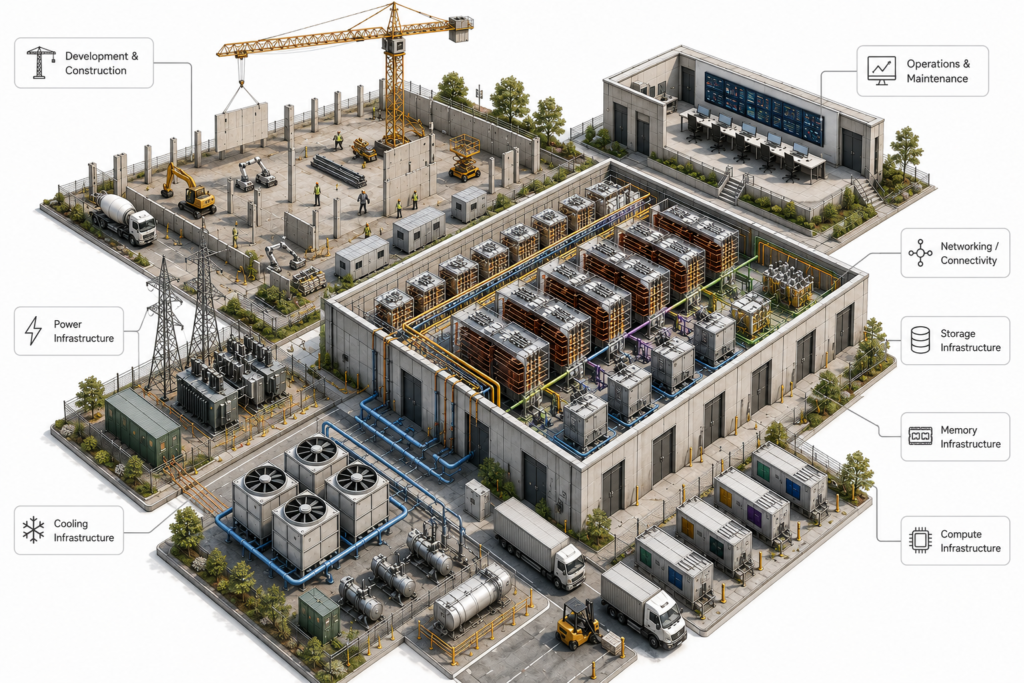
The modern data center stack spans seven interconnected layers, broadly grouped into physical infrastructure (data center development and construction, power, cooling, operations, maintenance, and ownership), connectivity (networking), and processing infrastructure (storage, memory, and compute). Drawing on expert insights, this report examines the physical infrastructure, exploring its current state, key deployment bottlenecks, and the innovations shaping the next generation of AI data centers.
02- Data Center Development and Construction
This layer forms the physical backbone of the AI economy, encompassing the construction, commissioning, and operation of the facilities that house the computing infrastructure behind modern artificial intelligence. To understand how the data center boom is changing the way these facilities are built, we spoke with two investors and innovation leaders embedded within major U.S. general contractors: Thai Nguyen, Director of Venture and Innovation at Diverge VC, and Parker Mundt, Partner at Suffolk Technologies.
Their vantage point sits between the construction site and the technology industry. Both evaluate emerging technologies while working closely with the project teams that ultimately have to determine whether those technologies can survive the realities of a jobsite. Their conversations point to an industry confronting a skilled labor shortage. Demand for data centers is growing extraordinarily quickly, but the physical systems needed to deliver them, from skilled electricians to switchgear and electricity itself, cannot expand nearly as fast.
The construction industry is transforming quickly.
Data centers have moved from a relatively niche segment of the construction market to one of its fastest-growing areas. The scale of that transformation is striking: annual construction spending on data centers has increased more than 2,600% since 2014, according to Associated Builders and Contractors.
That shift is reshaping not only what contractors build, but also how they operate. Mission Critical construction has become a major business segment, with contractors expanding specialized teams and taking on increasingly large and complex campuses for hyperscale technology companies. The surge is also putting pressure on the industry’s labor pool, particularly for electricians and other skilled trades.
Yet the industry’s ability to construct these facilities has not expanded nearly as quickly as demand. The challenge extends across the broader construction ecosystem, with labor shortages affecting the specialized contractors required to deliver increasingly complex data centers. Electrical trades, in particular, remain especially constrained.
The imbalance is particularly pronounced as demand for electricians rises while the number of people entering the trades fails to keep pace. “One of the biggest constraints right now is the availability of talent in the labor pool,” Mundt said. “Finding and recruiting the highly skilled talent needed to build the Mission Critical structures poses a unique challenge.”
This high labor demand is driving the emergence of new workforce technologies, such as Skillit, an AI-powered labor marketplace of vetted construction workers, that are reimagining how the industry finds and recruits skilled talent.
The labor shortage matters because hyperscale data centers are being built on schedules that leave little room for conventional construction inefficiencies.
The construction timeline for data centers effectively begins the moment a project is awarded. Permitting, site preparation, and underground utility work can follow in rapid succession.
Construction cycles are becoming similarly compressed across the sector, with some data center projects moving from groundbreaking to completion in roughly 12 months. One reason is that the industry has become more experienced and efficient at building these highly specialized facilities.
“They are going up faster because people are now more experienced in building them,” Mundt noted.
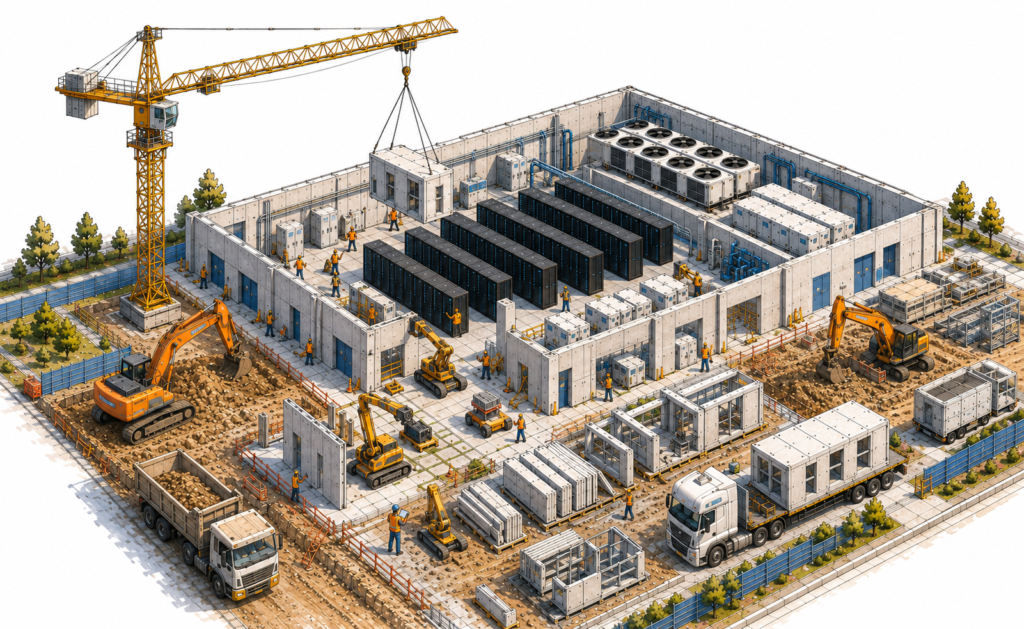
Unlike traditional commercial construction, which has historically relied on unique, custom-built structures, data center construction is becoming increasingly standardized and repeatable. That repeatability may prove to be one of the most consequential features of the current data center boom.
Commercial construction has historically been a business of one-offs. A hospital is different from an airport, and one office tower may bear little resemblance to the next. Designs change, subcontractors change, and site conditions change. The knowledge accumulated on one project does not always transfer cleanly to another.
Data centers begin to break that pattern. Hyperscalers may construct multiple facilities based on similar designs, and contractors can build the same type of infrastructure repeatedly. That makes it possible to take actual information from completed projects, including labor productivity, unit costs, and construction outcomes, and use it to plan the next one.
If a contractor has estimated and delivered five data centers, Mundt explained, the final numbers from those projects can be fed back into its estimating systems, such as Ediphi before bidding the sixth. The contractor begins the next project with a much clearer picture of what work actually costs and how long it takes.
The goal is not simply to make construction cheaper. It is to make it more predictable.
That creates a feedback loop more characteristic of manufacturing than conventional construction. Each facility can inform the next, shortening preconstruction and allowing contractors and their customers to forecast schedules with greater confidence.
The economics of data centers are also changing what contractors are willing to experiment with.
On most commercial projects, a new technology must typically justify itself through lower construction costs. Data centers introduce another variable: the value of time. Bringing a facility online even a few weeks earlier can allow a hyperscaler to deploy expensive computing equipment sooner.
“Working in data centers is a little bit different, because it’s all about speed optimization,” Mundt said.
That changes the calculation around technology. A system does not necessarily have to be cheaper if it can demonstrate that it meaningfully accelerates delivery. Clients can be less concerned with additional cost ” as long as you can prove to them that there’s a benefit from a speed perspective ” according to Mundt.
Robotics is becoming one of the clearest examples.
Layout work has traditionally required workers to move through large spaces with drawings, chalk lines, and tape measures, marking exactly where equipment should be installed. Robotic systems like Rugged Robotics can increasingly ingest a digital drawing and autonomously mark those locations across a data hall.
For a conventional project, the calculation might focus on how many labor hours the robot eliminates. For a data center, the more important question can be how much sooner the facility becomes operational. If work that once took a month can be completed in two weeks, those two weeks have considerable value to an owner trying to bring additional computing capacity online.
Diverge VC is seeing robotics spread into other parts of the jobsite. Nguyen said his teams have worked with robots for layout and are piloting machines that clean, grout, and perform drywall-related work. He believes advances in generative AI could accelerate the transition from machines that execute individual programmed tasks toward systems capable of interpreting schedules and production requirements with considerably less human supervision.
Neither Nguyen nor Mundt expects that evolution to eliminate construction workers anytime soon.
” The golden age for construction robotics is going to be a world in which robots are operating alongside humans, not replacing them,” Mundt said.
The foreman does not disappear because a robot performs layout. Instead, the robot completes the repetitive work while the foreman spends time on tasks requiring greater judgment and coordination.
Nguyen sees much the same dynamic. With contractors already struggling to fill positions, he questions whether a robot performing an unfilled role can meaningfully be described as taking someone’s job.
“There’s not a human there ready for that job,” he said.
There is also a safety argument. Some of the first tasks likely to be automated are precisely those workers would prefer not to perform.
“Who wants to tie rebar as their career?” Nguyen said. “Who wants to drill overhead, 15 feet up in the air?”
For Nguyen, those are natural applications for machines because they combine repetition, physical strain, and risk.
Technology is also being used to address the shortage before a worker reaches the jobsite. Mundt pointed to renewed interest in augmented and virtual reality training as contractors search for ways to compress years of accumulated field knowledge into shorter training cycles. The challenge is not simply getting inexperienced workers productive more quickly. They must do so safely on sites where schedules are already moving at extraordinary speed.
The industry’s labor problem, in other words, is creating pressure at both ends. Contractors need more people entering the trades, while simultaneously finding ways for each worker already in the field to accomplish more.
Prefabrication offers another way around the constraint.
Instead of assembling every component at the construction site, portions of electrical, mechanical, and structural systems can be manufactured in controlled environments and delivered ready for installation. Mundt said trade partners are already moving in this direction, assembling components off-site and delivering them as kits of parts. Data centers, with their relatively repetitive designs, offer a particularly attractive environment for the approach.
Nguyen expects the shift to accelerate. “In the next five years you’re going to see a ton more,” he said of prefabrication and modular construction.
Yet even an increasingly industrialized construction process still encounters bottlenecks that are stubbornly difficult to automate.Commissioning is one area where the construction industry remains ripe for greater automation. Before a building becomes operational, its electrical, mechanical and building systems must be tested, verified and coordinated. The process can be painstaking, particularly on large and technically complex data center projects, creating opportunities for technology to streamline workflows and reduce manual work.
“Commissioning, I mean, that’s such a painful process,” Nguyen said. “Any automation that you can put towards commissioning and workflow in that regard, I think it’s huge.”
Supply chains represent another vulnerability across construction. Projects often depend on large quantities of specialized materials and equipment, and a delay in a single critical component can bring an otherwise fast-moving project to a standstill. The challenge became particularly visible during recent supply-chain disruptions, when equipment such as electrical switchgear became difficult to procure.
“That will debilitate a job or a project,” Nguyen said.
Ultimately, however, both conversations return to a constraint that cannot be solved simply by building faster: electricity.
Power availability is becoming one of the largest constraints facing new data center construction. The scarcity is influencing decisions throughout the development process, from cooling systems and building layouts to the overall efficiency of a facility.
It is also changing the role contractors can play in the development process. Rather than simply executing a set of plans, contractors are increasingly being brought in earlier to help optimize facilities around power constraints, with a focus on more efficient building designs, layouts, modular systems and cooling technologies.
As data center demand continues to grow, efficiency is becoming increasingly important. The measure of a best-in-class facility is shifting beyond speed and scale to include how much computing output it can deliver relative to the space and electricity it consumes. Energy efficiency and computing output per square foot are likely to become increasingly important measures of performance.
Both ultimately depend on access to reliable, affordable power. With grid capacity increasingly constrained in many markets, the pressure is already pushing the industry to think beyond the grid. Mundt expects more discussion around power generation colocated with data centers and believes small modular nuclear reactors could eventually play a role if permitting and deployment challenges can be resolved. The attraction is straightforward. A data center operator able to secure its own reliable generation becomes less dependent on an electrical system that is increasingly struggling to accommodate new loads.
“If you can control your own destiny from an energy creation perspective,” Mundt said, “that’s a huge unlock for a lot of these data centers.”
Taken together, the experiences of Diverge VC and Suffolk Technologies suggest that the ai boom is beginning to change construction itself. Buildings are becoming more repeatable. Historical project data is feeding back into future designs and estimates. Work is moving from jobsites into factories. Robots are beginning to work alongside tradespeople. Training is being compressed. Contractors are being asked to participate earlier in decisions about efficiency and constructability.
The industry’s traditional equation is changing. For decades, contractors competed primarily around cost, schedule, and quality. Hyperscale computing has introduced another measure: how quickly a building can begin producing compute.
The race to build AI infrastructure is therefore becoming more than a race to pour concrete and erect data halls faster. It is pushing construction toward a more industrialized model, one built around repeatability, automation, and continuous learning. Yet even that transformation ultimately runs into the same physical boundary confronting the rest of the AI economy. The industry may learn to build data centers faster than ever before, it still has to find enough people and enough power to make them run.
03- Power Generation & Cooling
Securing reliable power has become one of the biggest challenges facing data center development. To understand how investors are navigating this rapidly evolving energy landscape, we spoke with Sam Hill of TDK Ventures and Tomas Rauch of TechEnergy Ventures, two investors focused on emerging energy and infrastructure technologies.
The scale of the challenge has changed dramatically. A decade ago, a 30-megawatt data center was considered large; today, 200-megawatt facilities are common. “Power is the gatekeeper,” Marc Ganzi, chief executive of DigitalBridge, told Wharton Magazine. Increasingly, the constraint is not whether electricity can be generated, but how quickly developers can access reliable power.
In parts of the United States, connecting a new facility to the grid can take more than a decade, while operators demand “five nines,” or 99.999% uptime.
Hill sees the same pressures reshaping investment priorities. While efficiency measures such as PUE still matter, he said “capacity, reliability, and speed have become paramount”. Securing sufficient grid power, building dependable backup systems, and finding ways to bring new generation online quickly are taking precedence as developers race to add computing capacity.
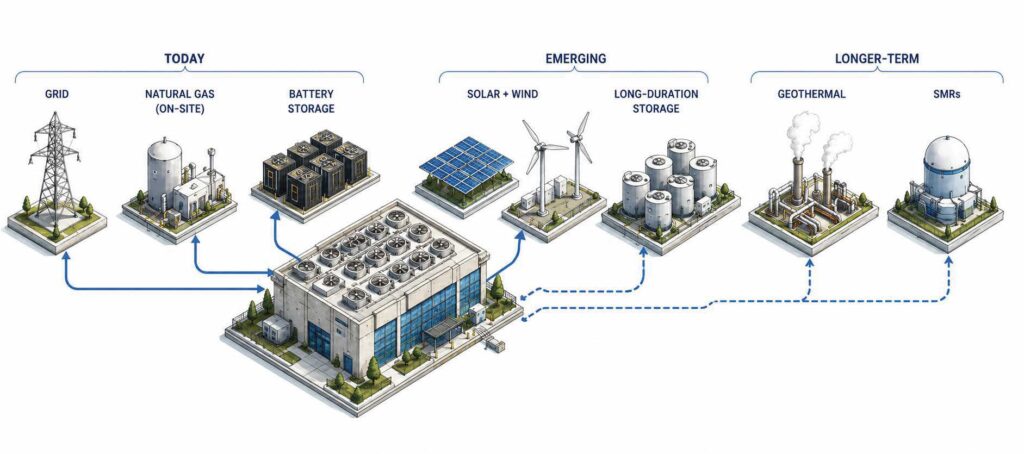
One result is the rise of behind-the-meter power, where electricity is generated at or near the data center rather than relying entirely on the grid. Developers are considering nuclear, wind, and solar, but natural-gas turbines have become the near-term preference because they can provide firm, around-the-clock power. Even that workaround is encountering constraints, however, as demand for gas turbines has created its own equipment shortages.
Today, the broader data center power mix remains heavily dependent on conventional generation. Utility Dive reports that 56% of electricity powering data centers comes from fossil fuels, 22% from renewables, and 21% from nuclear energy. But the search for reliable capacity is widening the range of technologies under consideration.
Rauch points to lithium-ion, sodium-ion, and broader battery solutions as technologies with significant potential, as operators look to reduce peak grid demand, strengthen backup power, and better integrate intermittent renewable generation. Form Energy recently raised $750 million to expand production of its iron-air batteries, which can deliver power for up to 100 hours, illustrating the growing investment in long-duration storage. The IEA estimates that 20 to 25 GW of battery storage could be installed at data centers globally by 2030. Together, these developments point toward a more distributed power model that combines grid electricity with on-site generation, storage, and increasingly, firm clean-energy sources.
Longer-term, the industry is searching for clean sources of dependable, around-the-clock electricity. Advanced geothermal and small modular nuclear reactors (SMRs) are among the technologies attracting attention. Rauch of TechEnergy Ventures sees geothermal as particularly promising because of its potential to provide baseload power at competitive economics. Advances in enhanced geothermal systems are widening the geographies where geothermal could work, although high capital requirements, technical hurdles, permitting, and supporting infrastructure remain significant barriers to deployment at scale.
Generating enough electricity, however, is only part of the problem. Getting that power into the facility and ultimately to the chips is becoming a bottleneck of its own. Transformers, switchgear, turbines, and other electrical equipment face growing supply constraints. Inside the facility, rising rack densities are also forcing a rethink of power distribution, including a shift toward higher-voltage DC architectures designed to reduce conversion losses and support megawatt-scale racks.
And all of that electricity creates another problem: heat.
For decades, cooling a data center was largely an exercise in moving air, but the density of AI compute is pushing conventional systems toward their limits. Cooling can also require significant amounts of water, adding another point of tension as data centers expand into communities already concerned about pressure on local water supplies. Wharton notes that energy, cooling water, and land use have all become sources of community opposition to new projects.
That pressure is turning water efficiency into another area of innovation. Developers are adopting closed-loop systems that recirculate water rather than continually consuming fresh supplies, while the industry shifts toward direct-to-chip liquid cooling, rear-door heat exchangers, and other approaches designed for increasingly dense AI hardware. Related Digital, for example, has adopted closed-loop cooling systems that use less water than the agricultural operations previously occupying some of its sites.
For operators, the challenge is increasingly to manage power, heat, and water together. Hill at TDK Ventures says operators are looking for cooling technologies that support greater compute density while reducing operational complexity, resource intensity, and environmental footprint. As AI racks grow more powerful, innovation in cooling is becoming as much about conserving scarce resources and unlocking additional compute capacity as it is about keeping chips from overheating.
04-Operations, Maintenance, and Ownership
Once a data center is built, the challenge shifts to keeping it running. Modern facilities operate around the clock, making uptime, maintenance, and asset utilization central to their economics. Maintenance increasingly combines continuous monitoring, inspections, and hardware replacement with predictive systems designed to identify equipment failures before they cause costly outages. With companies like Thalo Labs, NYC-based technology company building sensor and AI tools for HVAC companies, the combination of AI-powered software and hardware unlocks new potential for continuous monitoring of equipment to move from reactive to proactive maintenance, catching costly issues earlier.
As facilities become larger and more complex, AI, automation, and robotics are also beginning to supplement a workforce already facing significant labor shortages.
The ownership model is evolving alongside it. Hyperscalers can own facilities outright, lease capacity from specialized operators, or increasingly bring institutional investors into individual projects. Meta, for example, has used structures in which outside investors own the majority of the physical data center while Meta remains the long-term user. Crusoe represents a more vertically integrated version of the specialized-operator model, combining development and operations with energy infrastructure and cloud computing while partnering with institutional capital to finance large projects.
But AI is also changing the economics of the assets themselves. Nvidia, CEO Jensen Huang has argued that AI compute is emerging as an investable asset class. Unlike conventional servers, whose economics typically deteriorate alongside the hardware, AI infrastructure is showing signs that its productive value can improve even as the equipment ages. CoreWeave has reported resilient pricing for older GPU fleets, while Nebius has reported higher pricing for previous-generation GPUs. Improvements in inference software, including quantization, speculative decoding, KV-cache optimization, batching, routing, and scheduling, can allow the same GPU or megawatt of infrastructure to generate more tokens at a lower cost. In effect, the hardware may depreciate while the economic output it produces appreciates.
The boundaries are becoming even less distinct. In August, Nvidia agreed to invest $1.5 billion in SB Energy and provide a guarantee of up to $105 billion supporting OpenAI’s 20-year lease of an Ohio data center campus. SB Energy and SoftBank are also planning at least 10 GW of new power generation and billions of dollars of grid infrastructure around the project. The arrangement brings together a chipmaker, AI company, infrastructure developer, energy provider, and financial backers around the same computing asset.
As AI factories become larger and more expensive, the industry may increasingly separate who owns the land and buildings, who finances the power, who owns the GPUs, who operates the facility, and who ultimately consumes the compute. At the same time, better software is making the utilization of those assets as important as their physical ownership.
05 – The Data Center of the Future
The data center of the future may not look much like a data center at all. As AI strains the availability of land, power, and water, developers are beginning to rethink not just how these facilities are built, but where computing should happen.To understand where this next wave of innovation is taking shape, we mapped the emerging companies tackling critical bottlenecks across the data center buildout and operations stack.
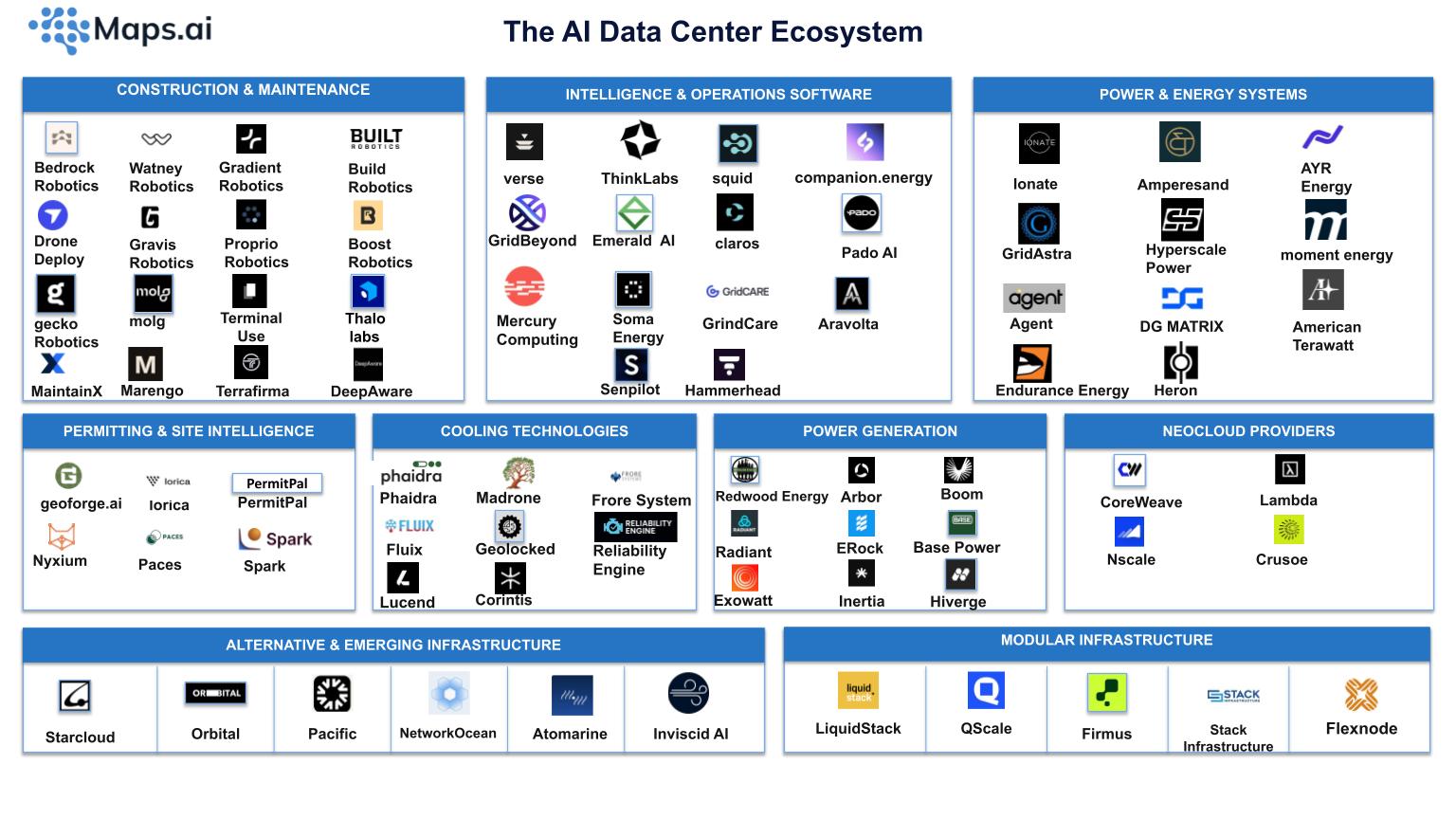
One shift is already underway: from construction to assembly. Prefabricated power, cooling, and computing modules can be manufactured off-site and deployed wherever capacity becomes available. JLL expects the modular and micro data center market to grow from roughly $11 billion in 2025 to $48 billion by 2030.
Computing may also become more geographically distributed. Massive campuses will still be needed for the most demanding AI workloads, but inference could move smaller facilities closer to users and wherever power is readily available. Further out, the boundaries of the data center are beginning to blur. AI chips have already operated in orbit. Companies are testing underwater facilities, quantum computers that require extreme temperatures and even biological forms of computing. The result could be a computing landscape in which the infrastructure looks very different depending on the work it is built to do.
The next generation of data centers, in other words, may not simply be bigger. They may be modular, distributed, and built wherever the economics of power, cooling, and computation make the most sense.